What is Executive Functioning (a Parent-Friendly Guide)

Does it sometimes feel like this for you or your child? Don’t know which tab to attend to first, leading to feelings of being overwhelmed? Well, there’s a reason for that!
Executive functions skills explained by an educational psychologist
Your Brain’s air traffic controller
Stuck in the final pages of a gripping novel that entices your very core, hurtling you towards a thrilling finale that has been bubbling and teased away for weeks, months on end, and then suddenly… the doorbell rings unexpectedly. You're presented with two choices: pause momentarily to see to the unknown caller or stay and finish that chapter to satiate the curiosity. For most, it’s a no-brainer, a temporary, albeit ill-timed interruption, with all the benefits of finding out who the visitor is and the purpose of the visit is much more preferred than staying for the book that’s ultimately not going anywhere. But for some…it’s definitely not that simple, or obvious. The little voice in their head that thinks through the possibilities and outcomes, both logical and emotional, before selecting the appropriate action is turned down to an inaudible whisper. Or…in other words, their executive functioning skills might be operating differently.
Executive functions (EF) are a set of mental skills that help us manage our thoughts, actions, and emotions to complete tasks and achieve goals. Now, this says nothing about your ability to make these decisions; it just shows which ones get done in which order or take precedence, a bit like a control tower at an airport. So think of EF like your brain’s air traffic controller!

What do I mean?
Just like an air traffic controller manages many planes at once, executive functions help us manage many things happening at the same time, such as:
remembering instructions
focusing attention
controlling impulses
planning what to do next
switching between tasks
Without a control tower, an airport would quickly become chaotic. Planes might try to land at the same time or take off without coordination.
In the same way, without strong executive functioning, a person may find it difficult to organise their behaviour and thinking.
So, in the hopefully clear and wonderfully visual metaphor, the “planes” are all the thoughts and tasks a person has to do, such as :
finishing a task
remembering what someone has said
Waiting for your turn
getting dressed in the morning
managing frustration
Executive functioning helps the brain decide which plane takes off first (prioritising), which plane waits (impulse control) and what the next steps are (planning).
The science-y bit
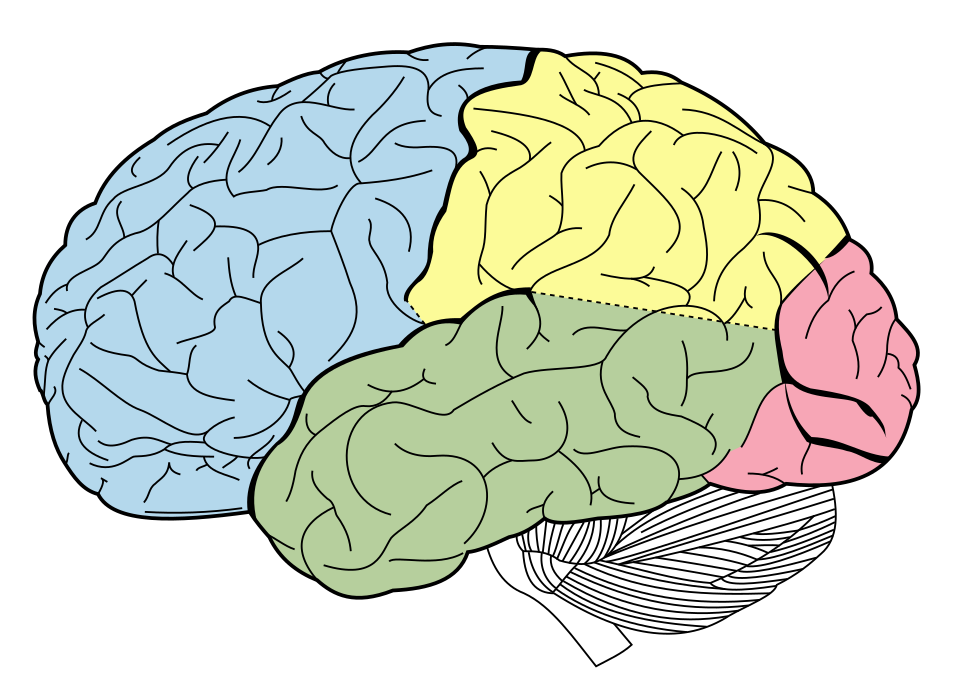
“I wanna be in “The lobe” where it happens”
The part of the brain responsible for all this magic falls squarely on the frontal lobe (the blue part of this image). otherwise known as the “sticky-out” part at the front of your brain.
While our brains are big, beautiful and wonderfully complex organs, certain parts no doubt do the majority of the heavy lifting for specific jobs. For executive functions, that responsibility falls on the frontal lobe. This area is where our most complex cognitive operations occur, such as our working memory (the ability to hold information in mind long enough to use it or tend to other information.), attention (shifting and maintaining), organisation of thought, impulse control and cognitive flexibility (adjusting when things change, trying a new strategy when one doesn’t work).
Ever wondered why stimulants such as Coffee, glucose or “proplus” help? Well, they “stimulate” electrical activity and blood flow to this exact part of the brain, helping you to feel more alert and reactive (providing you haven’t built up a heavy tolerance to caffeine due to excessive daily intake like a certain EP we all know).
Just as a fascinating curiosity, a lot of what we know about the impact of the frontal lobe on executive functions is thanks to the case of Phineas Gage, a railroad worker in the 1940s who suffered a catastrophic injury when a rail spike pierced his skull through the left frontal lobe. Miraculously, he survived; however, reports from those who knew him reported significant changes in both his personality and behaviour. Phineas lost impulse control, decision-making capabilities, and social inhibition, effectively becoming a night-and-day difference from the man he once was. I encourage you to look into his case further, but BE WARNED; images of the injury and aftermath from a purely scientific nature will ensue and may cause offence.
Why do some children struggle?
There’s no one size fits all when it comes to identifying why a child is struggling. But in some cases, it may be due to executive functioning differences or impairment. Difficulty in shifting attention, limiting distractions, returning to a task or knowing where to begin when faced with many options. If any of these sounds familiar, you could be staring at a problem with EF.
Executive Functioning is so complex, so involved in our day-to-day workings, that it is used as a behavioural marker for more serious disorders such as Autism (ASD) and Attention Deficit Hyperactivity Disorder (ADHD). While by no means is it sufficient by itself for diagnosing these conditions, research has shown that populations with ASD and ADHD show marked negative differences in their executive functioning.
So what can be done?

See the light through the trees!
How you think about your child’s performance can make all the difference to them.
You may be reading this while thinking of a specific child you know. You might even be reading this and seeing elements of yourself. The first thing to do is not to panic. As with most things in life, perspective is key. Take the above picture, for instance: you could see it as the sun being blocked by leaves, or as an evenly spread, shady respite from the heat! So what should you do? See the difference, not the disorder. Everyone has Executive functioning skills; the key thing is the volume of how loud it is, which varies from person to person. Whether through developmental experience or genetic factors, executive functioning can always be developed or enhanced to some degree! Patience, repetition and understanding are the key ingredients to developing EF. Daily adaptations to your schedule, such as implementing visual timetables, schedules and checklists, are perfect tools. Make memory items more distinctive by adding colour or sound (i.e. sing the schedule or have them associate a colour with the item) to help draw their attention back with a cue. Lastly, old-fashioned pencil & paper games like mazes, word searches, crosswords, and Where’s Wally/Waldo are fantastic tools to help them develop mental discrimination tactics (i.e., blocking out irrelevant distractors). There are many more strategies and resources out there, but which one is right for you is best determined through a direct dialogue with a professional.
“…Executive functioning can always be developed to some degree! patience, repetition and understanding are the key ingredients…”

Get a professional involved
Because it doesn’t hurt to have a second opinion….especially for free
The mind is a minefield! Not only do you have to manage your little ones, but you also have yours to tend with, usually while everyone offers you a piece of theirs, whether you asked for it or not! Which is why it is always best to speak to someone outside of your realm of worries and stress, but who can offer you evidence-informed and rational guidance. Professionals such as child psychologists, neuropsychologists, and Paediatricians are trained to identify patterns of behaviour linked to EF. Sometimes your concerns may be nothing, and that’s fine. Sometimes they may be signals of something else, and that’s ok too. Either way, share them! even better; share them for free. At Emerald Bridges CPAS, we don’t believe knowledge, empathy and understanding should be gatekept. Which is why we pride ourselves on our 30-minute free Telephone consultation. A chance to talk and be heard. No sales tactics, no gate-keeping, just a chance for you to speak with a professional who is here to help. Just as these people have benefited from, call today to arrange your consultation and unlock that peace of mind and confidence you deserve as a caregiver.

Esmeralda Florence
“Oi, Tudo Bem? My name is Esmeralda Florence, and I’m from Minas Gerais, Brazil! I’m 24 years old and a Cognitive Science graduate! I love helping people understand how their brains work and why we do the things we do! I’m currently learning a lot about Executive Functioning and would love to share some of my ideas with you! Would you like that? Otimo! Great! Look out for some of my EF Tips coming soon! Não vejo a hora! I can’t wait!!! “